
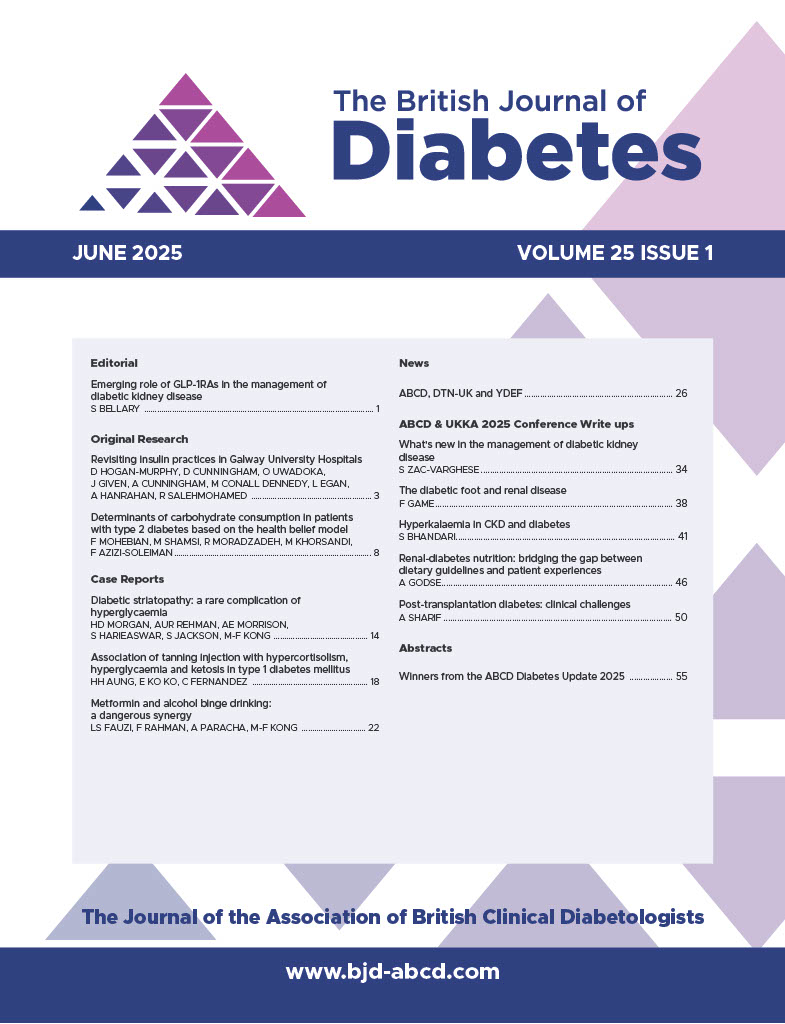
What's new in the management of diabetic kidney disease
The following write up is from the 7th Joint Meeting of ABCD & UKKA 2025 which was held on the 12th February 2025 at the Holiday Inn, Birmingham airport.
DOI:
https://doi.org/10.15277/bjd.2025.479Keywords:
diabetic kidney disease, diabetic nephropathy, chronic kidney diseaseAbstract
Diabetic kidney disease (DKD) management is a rapidly evolving field. Alongside risk prediction tools, such as the Kidney Failure Risk Equation, there is greater emphasis on person-centred care and education.
For people with type 2 diabetes (T2DM), sodium-glucose cotransporter 2 inhibitors (SGLTi) and finerenone have joined the five previous pillars of care which are foundations for both type 1 diabetes (T1DM) and T2DM. These include blood glucose optimisation, blood pressure management, renin–angiotensin–aldosterone system inhibitors (RAASi), lipid management and smoking cessation. The evolution of hyperkalaemia management, due to the availability of potassium binders, has enabled the optimal use of RAASi.
Ongoing studies in people with T1DM will further inform DKD management in the future.
References
Cook S, Schmedt N, Broughton J, Kalra PA, Tomlinson LA, Quint JK. Characterising the burden of chronic kidney disease among people with type 2 diabetes in England: a cohort study using the Clinical Practice Research Datalink. BMJ Open 2023;13(3):e065927–065927. https://doi.org/10.1136/bmjopen-2022-065927
Rossing P, Groop P, Singh R, Lawatscheck R, Tuttle KR. Prevalence of chronic kidney disease in type 1 diabetes among adults in the US. Diabetes Care 2024;47(8):1395–9. https://doi.org/10.2337/dc24-0335
Sundström J, Norhammar A, Karayiannides S, et al. Are there lost opportunities in chronic kidney disease? A region-wide cohort study. BMJ Open 2024;14(4):e074064. https://doi.org/10.1136/bmjopen-2023- 074064
Kidney Disease: Improving Global Outcomes (KDIGO) CKD work group. KDIGO 2024 clinical practice guideline for the evaluation and management of chronic kidney disease. Kidney Internat 2024;105(4S):S117–S314. https://doi.org/10.1016/j.kint.2023.10.018
NICE. Scenario: Management of chronic kidney disease. https://cks.nice.org.uk/topics/chronic- kidney-disease/management/management-of-chronic-kidney-disease/
Barlovic DP, Groop P. Special conditions: kidney disease. In: Camm AJ, Lüscher TF, Maurer G, Serruys PW. (eds.) The ESC Textbook of Cardiovascular Medicine. Oxford University Press; 2018. pp. 0.
Karalliedde J, Winocour P, Chowdhury TA, et al. Clinical practice guidelines for management of hyperglycaemia in adults with diabetic kidney disease. Diabetic Medicine 2022;39(4):e14769. https://doi.org/10.1111/dme.14769
Banerjee D, Winocour P, Chowdhury TA, et al. Management of hypertension in patients with diabetic kidney disease: summary of the Joint Association of British Clinical Diabetologists and UK Kidney Association (ABCD-UKKA) Guideline 2021. Kidney international Rep 2022;7(4):681–7. https://doi.org/10.1016/j.ekir.2022.01.004
Zac-Varghese S, Mark P, Bain S, et al. Clinical practice guideline for the management of lipids in adults with diabetic kidney disease: abbreviated summary of the Joint Association of British Clinical Diabetologists and UK Kidney Association (ABCD-UKKA) Guideline 2024. BMC Nephrol 2024;25(1):216 https://doi.org/10.1186/s12882-024-03664-1
Dasgupta I, Zac-Varghese S, Chaudhry K, et al. Current management of chronic kidney disease in type-2 diabetes-A tiered approach: an overview of the joint Association of British Clinical Diabetologists and UK Kidney Association (ABCD-UKKA) guidelines. Diabetic Medicine 2025;42(2):e15450. https://doi.org/10.1111/dme.15450
Alfonzo A, Harrison A, Baines R, Chu A, Mann S. Clinical practice guidelines treatment of acute hyperkalaemia in adults. UK Kidney Association. [Accessed 29/04/2025].
Rosenstock J, Marquard J, Laffel LM, et al. Empagliflozin as adjunctive to insulin therapy in type 1 diabetes: the EASE trials. Diabetes Care 2018;41(12):2560–9. https://doi.org/10.2337/dc18-1749
Mathieu C, Rudofsky G, Phillip M, et al. Long-term efficacy and safety of dapagliflozin in patients with inadequately controlled type 1 diabetes (the DEPICT-2 study): 52-week results from a randomized controlled trial. Diabetes, Obes Metab 2020;22(9):1516–26. https://doi.org/10.1111/dom.14060
Groop P, Dandona P, Phillip M, et al. Effect of dapagliflozin as an adjunct to insulin over 52 weeks in individuals with type 1 diabetes: post-hoc renal analysis of the DEPICT randomised controlled trials. Lancet Diabetes Endocrinol 2020; 8(10):845–54. https://doi.org/10.1016/ S2213-8587(20)30280-1
Groop P, Thomas MC, Moran JL, et al. The presence and severity of chronic kidney disease predicts all-cause mortality in type 1 diabetes. Diabetes 2009;58(7):1651–8. https://doi.org/10.2337/db08-1543 [Accessed Jul 31, 2019].
Agarwal R, Filippatos G, Pitt B, et al. Cardiovascular and kidney outcomes with finerenone in patients with type 2 diabetes and chronic kidney disease: the FIDELITY pooled analysis. Eur Heart J 2022;43(6):474–84. https://doi.org/10.1093/eurheartj/ehab777
Heerspink HJL, Birkenfeld AL, Cherney DZI, et al. Rationale and design of a randomised phase III registration trial investigating finerenone in participants with type 1 diabetes and chronic kidney disease: the FINE-ONE trial. Diabetes Res Clin Pract 2023;204:110908. https://doi.org/10.1016/j.diabres.2023.110908
Published
Issue
Section
License
Copyright (c) 2025 British Journal of Diabetes

This work is licensed under a Creative Commons Attribution 4.0 International License.
Manuscripts published in the June 2024 edition and after in the BJD have been published in open access under a Creative Commons Attribution 4.0 International License and available at https://www.bjd-abcd.com. Prior year articles are available free of charge via our website.